

Thinking of going scuba diving, but feeling a bit apprehensive about decompression sickness and getting the bends? You’re not the only one! But here are our top, easy tips on how to help prevent the bends on a dive.
The Bends is also known by its more official term, decompression sickness (DCS). Decompression sickness occurs when a person becomes ill due to changing from a high-pressure environment to a lower-pressure environment. This most commonly happens in scuba diving when changing depths during a dive, moving from a deeper depth (more pressure) to a shallower depth (less pressure).
Symptoms of the Bends
The most prominent symptoms of the bends include:
- Local joint pain (mainly in shoulders, elbows, wrists, hips, knees, and ankles)
- Weakness in the arms and legs
- Headache
- Dizziness
- Trouble thinking clearly
- Numbness and tingling
- Extreme fatigue
How to Prevent the Bends
Scuba diving is a very safe activity when you follow the rules of recreational diving. These are outlined during your Open Water scuba diving course, and your instructor will reiterate them often. The risk of getting the bends, or getting “bent” is significantly lowered by following these guidelines.
Follow Your NDLs
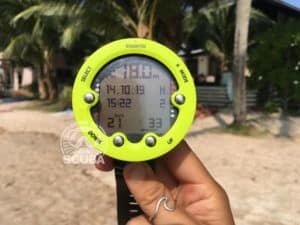
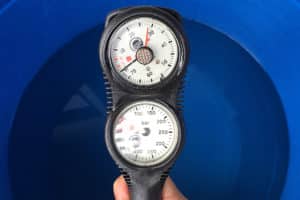
An NDL (No-Decompression Limit), also called a No-Stop time, is the maximum time a diver can spend at a certain depth before absorbing too much nitrogen to ascend directly to the surface without completing additional decompression stops. These limits were originally created and published by the US Navy to regulate underwater time and reduce the risk of DCS. Over time, different companies have refined the algorithms based on various factors to create their own NDL calculations (though most are very similar).
No-decompression limits vary from dive to dive depending on depth and previous recent dive profiles, which is why you should never share a dive computer with someone else.
If you are diving with a buddy whose dive computer shows a different NDL, always follow the most conservative limit.
As recreational divers, adhering to NDLs means we can ascend to the surface at any point during the dive, for whatever reason, without increasing the risk of getting the bends.
Ascend and Go Up Slowly
You should always ascend slowly from every dive, no matter how deep you were. During the dive, you breathe compressed air and absorb nitrogen into your muscles, tissues, and even your bones. As you move from deeper to shallower water and pressure decreases, that nitrogen expands.
By ascending slowly, you give your body time to safely release excess nitrogen.
The Professional Association of Diving Instructors (PADI) recommends not ascending faster than 18 meters / 60 feet per minute, meaning it should take longer than one minute to ascend 18 meters / 60 feet.
Other agencies are more conservative and recommend not ascending faster than 9 meters / 30 feet per minute.
My personal Suunto dive computer is set to 10 meters / 33 feet per minute and will beep if I exceed that rate. That’s my signal to SLOW DOWN, which I can do by:
- Stopping kicking
- Letting some air out of my BCD
- Breathing out
Personally, I like to ascend super, super slowly. It gives me more time underwater (which is why I’m diving in the first place!) and ensures I’m releasing as much nitrogen from my system as possible. That lowers my risk of the bends.
Keep Hydrated
You might think scuba diving isn’t physically demanding because you’re not constantly breaking a sweat, but it absolutely is. You’re putting strain on your body, from lifting and carrying a scuba tank, bending to pick up fins, swimming on the surface, climbing ladders, breathing dry compressed air and absorbing nitrogen. Your body is constantly working, and it needs proper hydration to function at its best.
And hydration doesn’t mean just any liquids – we mostly mean water and electrolytes.
I once had a student who experienced cramping in his hands and thought he had the bends. We called medical services. They assessed him and asked about his fluid intake over the previous 36 hours.
“Yeah, I’ve been drinking,” he said.
“Have you been drinking lots of water?”
“Yeah, I had a coffee on the plane yesterday.”
“Any water?”
“Well… no, but I had a coffee.”
Coffee and tea aren’t enough, especially not in a tropical, humid environment where you’re already sweating, then exerting yourself on a boat and underwater.
Signs of dehydration and heat exhaustion can closely mirror the symptoms divers fear most, the bends, or decompression sickness, including muscle cramps, dizziness, confusion, and overwhelming fatigue. It’s easy to see how a diver could misinterpret what’s happening in their body, especially after a demanding dive day in the sun. What makes this overlap even more important is that dehydration doesn’t just mimic decompression sickness; it can also increase susceptibility to it. When you’re dehydrated, blood volume decreases and circulation becomes less efficient, potentially impairing the body’s ability to eliminate dissolved nitrogen effectively. In other words, dehydration can both look like decompression sickness and make a diver more vulnerable to it, which is why proper hydration is a fundamental part of dive safety and reducing your risk of the bends.
Don’t Overexert Yourself
Avoiding overexertion is another important way to reduce the risk of decompression sickness. When you push yourself hard, whether that’s fighting a current, hauling heavy gear in the heat, or swimming aggressively underwater, your muscles demand more oxygen and produce more carbon dioxide and metabolic waste. This can increase circulation and nitrogen uptake during the dive, and intense exertion near or after ascent may promote bubble formation at a time when your body is trying to off-gas safely.
Heavy exertion also raises core temperature and adds physiological stress, compounding factors like dehydration and fatigue. Diving should be deliberate and controlled, not a race. Moving efficiently, planning conservatively, and avoiding unnecessary strain before, during, and immediately after a dive helps keep your body in a state where it can eliminate nitrogen more effectively and lowers your overall decompression risk.
Reduce Your Risk of The Bends
At the end of the day, scuba diving is a very safe activity. I’ve done over 4,000 dives and have never been “bent.” That’s not to say it’s impossible, or that I’m somehow immune but I do my best to be a safe, conservative diver. However, even someone on their fifth dive who follows every rule can still experience decompression sickness.
What we’re trying to do isn’t eliminate risk entirely, that’s impossible. What we can do is reduce the risk of “the bends” as much as possible. By following established guidelines, diving conservatively, monitoring your depth and time, making proper safety stops, staying hydrated, and listening to your body, you dramatically lower the chances of a problem.
Scuba diving rewards preparation and discipline. Dive smart, dive within your limits, and respect the science behind it, and you’ll give yourself the best possible odds of enjoying a lifetime of safe, unforgettable dives.









Leave a Reply
You must be logged in to post a comment.