
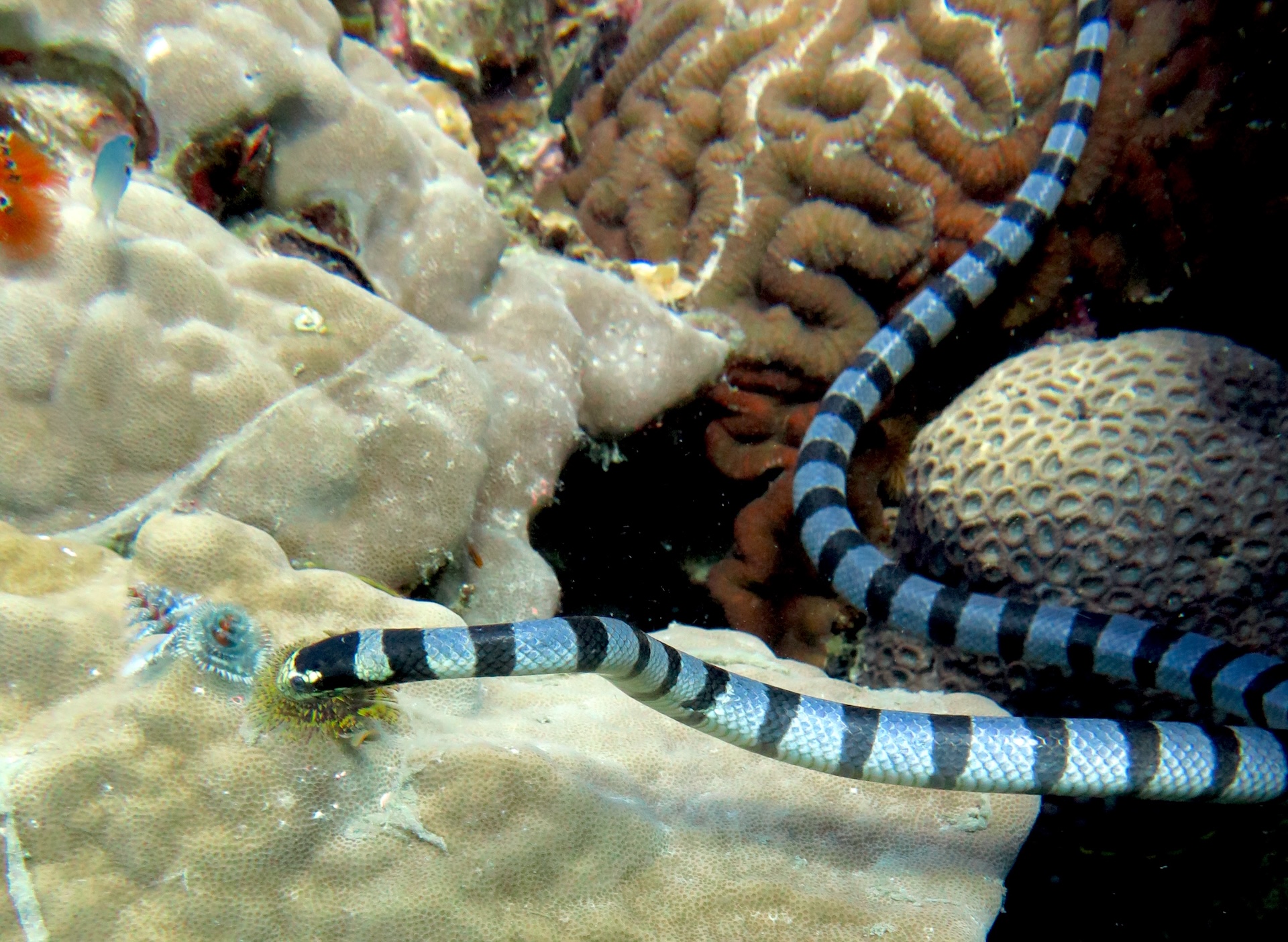
Imagine a creature that looks like a floating zebra, swims like a fish, but breathes air just like you do. Oh, and it’s a snake. Oh, and it’s been known to swim along your legs, how do I know? Because that’s what happened to me on a scuba dive! Meet the Banded Sea Krait (Laticauda colubrina), also known as the yellow-lipped sea krait. These stunning reptiles are some of the most fascinating residents of the coral reefs in the Indian and Pacific Oceans.
What is a Banded Sea Snake?
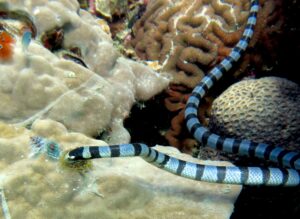
The Banded Sea Krait is a species of venomous sea snake easily recognised by its distinct black and silver-blue striped bands. While they spend much of their time underwater, they aren’t actually fish, they are reptiles!
Unlike “true” sea snakes that spend their entire lives in the water, kraits are semiaquatic. They have a paddle-shaped tail that acts like an oar to help them zoom through the waves, but they still have the belly scales of a land snake, which allows them to move around on shore.
How Dangerous is a Sea Snake?
This is the question everyone asks! Here is the honest truth:
- The Venom: Banded Sea Kraits have incredibly powerful neurotoxic venom. In fact, their venom is many times stronger than a King Cobra snake!
- The Personality: Even though they are “highly venomous,” they are known for being docile and shy. They almost never bite humans unless they are feel extremely threatened or are accidentally stepped on.
- The Teeth: They have very small fangs located at the front of their mouths. Because they are so calm, divers often swim right next to them without any trouble.
Safety Note: Just because they are friendly doesn’t mean you should touch them! Always give wild animals plenty of “personal space.” You should also never pick up, touch, prod, or annoy anything underwater (or on land).
Can Sea Kraits Survive on Land?
Yes! In fact, they must come to land to survive. While true sea snakes give birth to live young in the water, Banded Sea Kraits are “oviparous,” which means they lay eggs.
They crawl onto rocky islands or sandy beaches to:
- Lay their eggs in crevices or caves.
- Digest their food (the warmth of the land helps their tummies work).
- Molt (shed their skin).
- Drink fresh water from rain puddles.
Diet and Behaviour: The Eels’ Worst Nightmare
If you’re a moray eel, the Banded Sea Krait is your #1 villain. These snakes are specialised hunters with a very specific menu.
- The Eel Specialist: Most of their diet consists of eels. Because eels are long and thin, they fit perfectly inside the snake’s narrow body.
- A Group Effort: Interestingly, these snakes are known to hunt in “teams” with schools of fish like Goatfish and Trevally. The fish chase the eels into the cracks of the coral, and the sea krait slithers in to catch them.
- Night Owls (Sort of): While they can be active during the day, they often do their heaviest hunting at night when eels are most active.
- Holding Their Breath: Even though they have lungs, they are incredible divers. A Banded Sea Krait can stay underwater for up to two hours on a single breath!
How Big Do They Get?
You won’t find these snakes growing as long as a giant python, but they are still impressive.
- Average Length: Most grow to be about 1 meter (3.3 feet) long.
- Girls vs. Boys: Female Banded Sea Kraits are the “giants” of the family. They are significantly larger and heavier than the males!
- The “Two-Head” Trick: Have you ever noticed their tail looks a lot like their head? They use this as a defence mechanism to trick predators (like sharks or hawks) into thinking they are watching them, even when their head is tucked into a coral crevice looking for eels.
What are the Venom Effects of a Banded Sea Krait?
In the very unlikely, highly unprobable event that you were bitten by a sea krait, the most important thing is to stay calm. If you’re scuba diving, you must resist the urge to panic and instead signal to your buddy and head to the surface SLOWLY and safely to avoid other diving injuries.
The venom of a Banded Sea Krait is a powerful neurotoxin, which means it attacks the body’s nervous system. At first, a person might feel dizzy, nauseated, or have pain in their stomach. However, the venom works quickly. As it spreads, it can cause severe muscle cramps and progressive paralysis, which means the muscles stop being able to move. Because our lungs need muscles to breathe, the biggest danger is respiratory failure and suffocation. Without medical treatment, the venom can also damage the kidneys, and a person could become very ill within just 4 to 8 hours.
Medical treatment would include fluids and a respirator; basically just trying to keep the body functioning. Some hospitals may also have anti-venom, but don’t rely on this, as a lot of scuba diving sites are in less developed areas that are remote and far from major hospitals.
The good news? Because these snakes are so shy, bites are really super rare, and there has been no recorded human deaths from a banded sea krait!
Why are Banded Sea Snakes Important?
You might wonder why we need venomous snakes in our beautiful oceans. The truth is, the ecosystem would be in big trouble without them.
1. Population Control
As “apex predators” (animals at the top of the food chain) for specific prey, they keep the eel population in check. Without the kraits, there would be too many eels, which would then eat too many smaller fish, throwing the whole reef out of balance.
2. The “Health Check” of the Reef
Scientists look at sea snakes to see how healthy the ocean is. Because these snakes spend time on both land and water, they are very sensitive to pollution. If the sea snakes are healthy and happy, it’s usually a sign that the coral reef is doing well, too.
3. Medical Mysteries
Believe it or not, the venom that makes them dangerous is actually helping humans! Scientists study the proteins in sea krait venom to develop new medicines for pain, blood pressure, and even brain disorders.




Leave a Reply
You must be logged in to post a comment.